
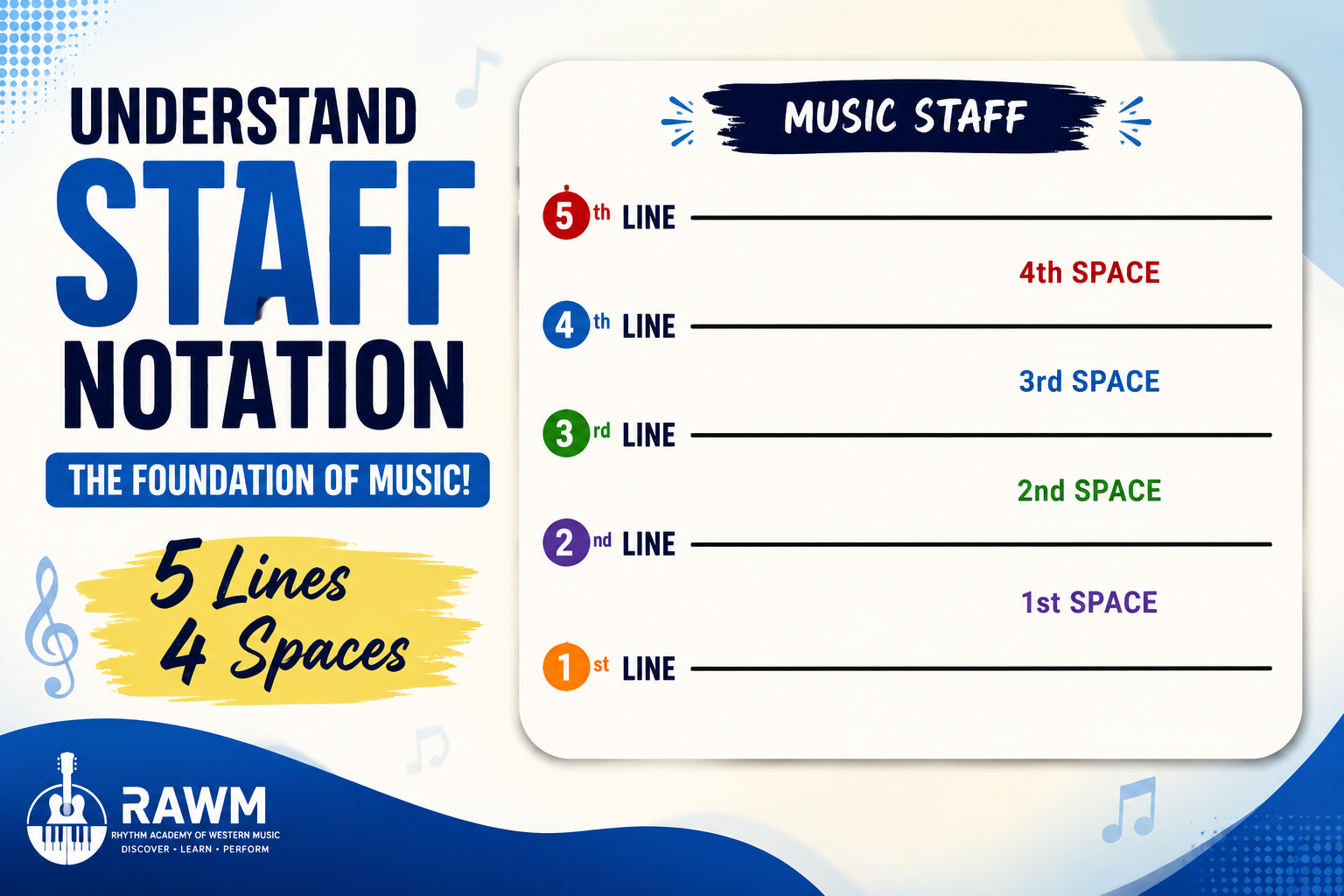
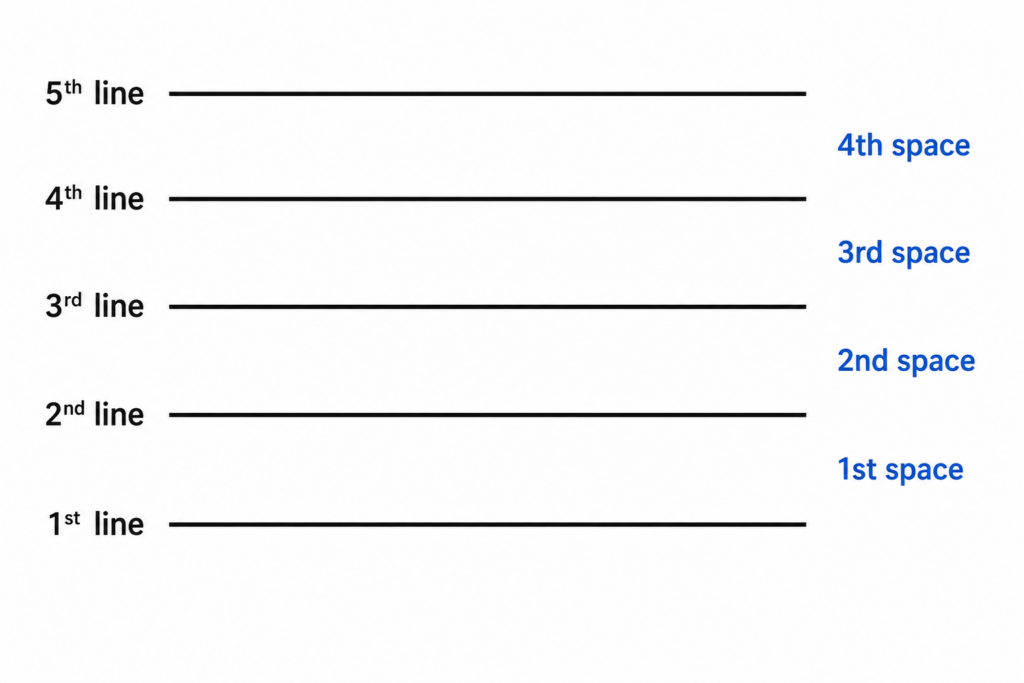
The foundation of staff notation is the staff. A standard musical staff consists of: 5 horizontal lines and 4 spaces.
The lines and spaces are counted from the bottom upward.
The position of a note on the staff helps identify its pitch.
However, the same position can represent different notes depending on the clef being used.
Why Are There Five Lines?
The five lines provide a visual framework for representing different pitches.
Notes placed higher on the staff generally represent higher pitches, while notes placed lower generally represent lower pitches.
This gives musicians a visual way to understand the movement of melody.
For example:
Notes moving upward → generally higher pitch
Notes moving downward → generally lower pitch
This is one of the first concepts beginners learn when studying music notation.
What Are the Spaces on the Staff?
Between the five lines are four spaces.
The spaces are also used to represent musical notes.
Therefore, notes can appear:
- On a line
- In a space
- Above the staff
- Below the staff
When music goes beyond the range of the five lines, additional short lines called ledger lines can be used.
What Are Ledger Lines?
Ledger lines are short horizontal lines placed above or below the staff.
They allow musicians to write notes that are too high or too low to fit within the normal five-line staff.
For example, a piano has a much wider range than can be represented by only five lines.
Ledger lines therefore extend the musical staff when necessary.