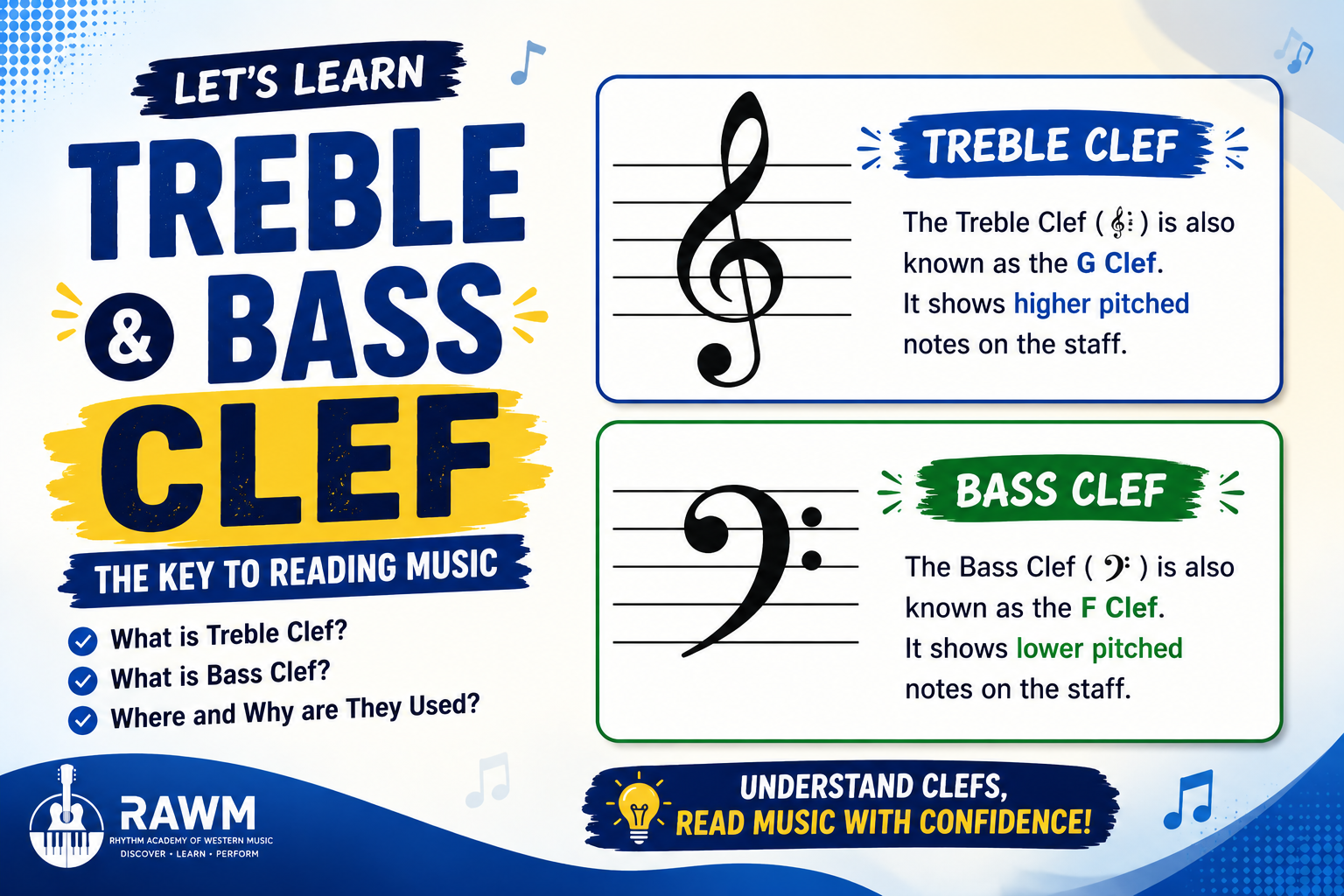
A clef is a symbol placed at the beginning of a staff to tell the musician which pitches the lines and spaces represent.
The most common clefs beginners encounter are:
Treble Clef
The Treble Clef, also called the G clef, is commonly used for higher-pitched instruments and musical parts.
It is frequently used for:
- Guitar
- Violin
- Flute
- Right hand of piano
- Higher keyboard parts
- Many vocal parts
Bass Clef
The Bass Clef, also called the F clef, is generally used for lower-pitched music.
It is commonly used for:
- Bass guitar
- Cello
- Lower piano parts
- Left hand of piano
- Low-register instruments
Learning clefs is essential because the same line or space can represent a different note depending on the clef.
Notes on the Treble Clef
For beginners learning treble clef, the notes on the lines are:
E – G – B – D – F
The notes in the spaces are:
F – A – C – E
The four spaces spell:
FACE
This can be a useful memory aid for beginners.
For the lines, teachers may use a simple mnemonic such as:
Every Good Boy Deserves Fun / Every Good Boy Does Fine
However, students should gradually learn to recognise the notes directly rather than depending entirely on mnemonics.
Notes on the Bass Clef
The notes on the lines of the bass clef are:
G – B – D – F – A
For the lines, teachers may use a simple mnemonic such as:
Good Boy Does Fine Always
The notes in the spaces are:
A – C – E – G
For the spaces, teachers may use a simple mnemonic such as:
All Cow Eat Grass.
Students learning piano or keyboard should become familiar with both treble and bass clefs.